
05.22.2026 Brenden Moore
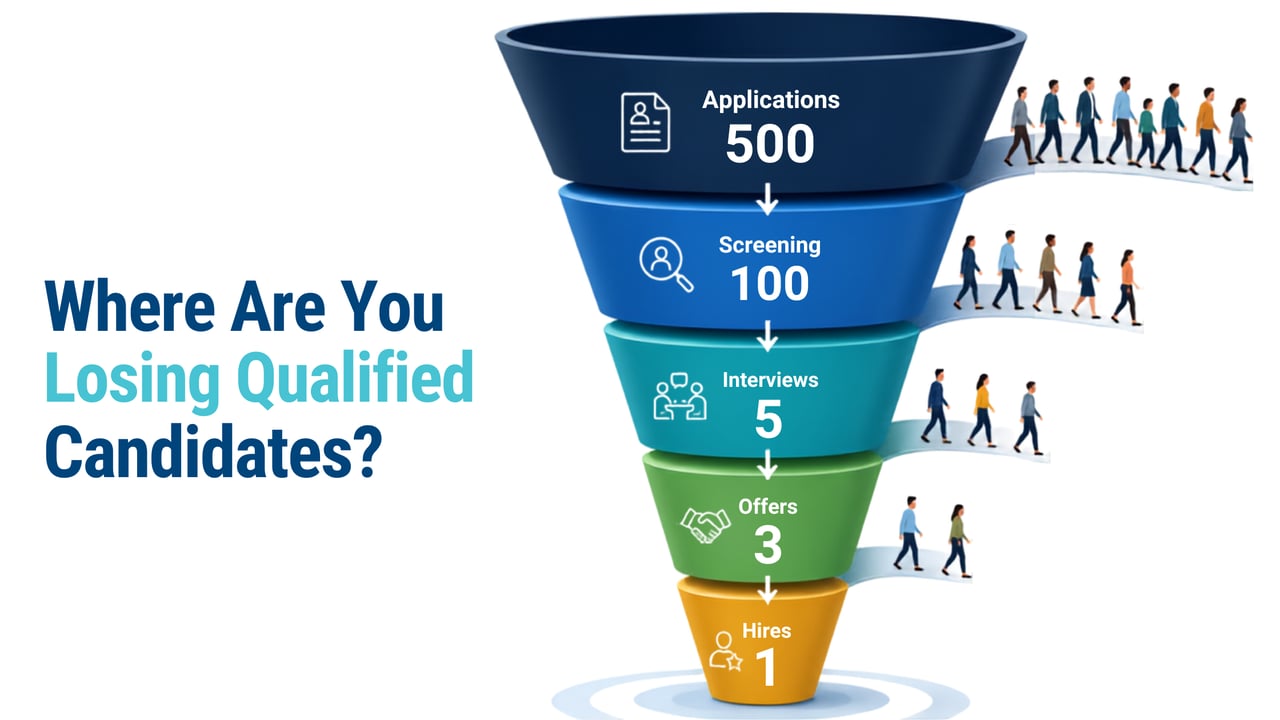
For years, recruiting conversations focused on one question: How do we attract more candidates?
Organizations invested heavily in job boards, advertising, employer branding, referral programs, and sourcing strategies designed to increase the number of people entering the hiring funnel.
Those efforts still matter. But for many organizations, the bigger challenge has shifted.
Today, the problem is often not attracting candidates. It's keeping the right candidates engaged long enough to become employees.
In other words, recruiting has increasingly become a trust and conversion problem.
More Candidates Doesn't Always Mean More Hires
Many hiring teams continue to measure recruiting success by the number of people entering the hiring process.
Views > Clicks > Applications > Applicant volume
While those metrics are important, more applications don't automatically lead to more hires. Organizations can generate hundreds of applicants and still struggle to fill critical positions. Why?
Because candidates are evaluating employers just as carefully as employers are evaluating candidates. Every interaction throughout the hiring process influences whether a candidate stays engaged or decides to pursue another opportunity.
No matter how strong applicant flow may be, it cannot compensate for a poor candidate experience or a broken hiring process.
The Candidate Journey Matters More Than Ever
Today's candidates have more information, more options, and often more opportunities competing for their attention.
As a result, the hiring process itself has become a major factor in recruiting success.
Candidates are paying attention to questions like:
- How quickly did the organization respond?
- Was communication clear and consistent?
- Did the interview process feel organized?
- Did the opportunity match what was initially presented?
- Did the employer demonstrate genuine interest?
When candidates answer "yes," confidence grows and engagement typically increases. When uncertainty enters the process, candidate drop-off often follows.
In many cases, organizations don't lose candidates because of compensation or competition. They lose them because trust has gradually eroded throughout the hiring process.
Candidate Drop-Off: The Hidden Recruiting Challenge
One of the most overlooked recruiting metrics is candidate drop-off. Candidate drop-off occurs when qualified candidates exit the hiring process before becoming employees.
It can happen at virtually any stage:
- During the application process
- After initial screening
- Between interviews
- During offer negotiations
- Before the first day of employment
The challenge is that many organizations don't know where this drop-off is occurring.
Without visibility into the recruiting funnel, hiring teams often assume they need more applicants when the real issue lies within the hiring process itself.
Candidate Conversion Is the New Recruiting Metric
Marketing teams have long understood the importance of conversion. Generating website traffic is only valuable if visitors stay engaged and take action.
Recruiting operates much the same way. Generating applications is only beneficial if qualified candidates continue moving through the hiring funnel and ultimately become hires.
That requires organizations to look beyond applicant volume and understand where candidates are dropping off along the way.
For example:
- How many applicants complete initial screening?
- How many qualified candidates move to interview?
- How many interviews result in offers?
- How many offers become accepted hires?
These hiring funnel metrics often reveal where recruiting challenges actually exist. A hiring team may not need more applicants.
They may simply need to improve the process that converts qualified candidates into employees. An organization may discover that application volume is healthy, but candidate drop-off increases dramatically between screening and interviews.
Another may find that strong candidates consistently accept interviews but decline offers. Each scenario points to a different challenge and requires a different solution.
Without understanding these conversion points, organizations often invest additional time and money into sourcing when the real opportunity exists within the hiring process itself.
The Hiring Process Shapes Candidate Perception
Trust is rarely built through a single interaction. It is earned—or lost—through a series of small experiences throughout the candidate journey.
Prompt communication. Clear expectations. Respect for a candidate's time. Consistent follow-up. A well-organized process.
Individually, each action may seem minor. Collectively, they shape how candidates perceive an organization.
Delays, lack of communication, or confusing processes often signal to candidates how the organization operates as a whole. Whether that perception is accurate or not, it influences their willingness to continue.
When hiring teams consistently build trust throughout the process, they gain an advantage that extends beyond compensation, benefits, or employer brand recognition.
A Better Question for Hiring Teams
Asking, "How do we attract more candidates?" may no longer be the most valuable question. A more important question may be: "Where are we losing qualified candidates today?"
The answer often reveals opportunities to improve hiring outcomes without increasing recruiting spending. For some organizations, the issue is speed. Qualified candidates wait too long between application, screening, and interview.
For others, the challenge is communication. Candidates become disengaged when expectations are unclear or updates are inconsistent. Some organizations discover their hiring process is unnecessarily complex.
Candidates exit the process because of multiple interview rounds, scheduling delays, or repeated requests for information.
Others experience misalignment between recruiters, hiring managers, and candidates, creating confusion around the role, timeline, or opportunity itself.
The solutions are often straightforward:
- Faster communication
- Simplified interview processes
- Better alignment between recruiters and hiring managers
- Clearer expectations from the beginning
These improvements frequently produce meaningful results because they focus on candidate conversion rather than applicant volume.
The goal is not simply to attract more people into the funnel. It's to help the right people move through it successfully.
Quick Assessment: Where Are Candidates Dropping Off?
If hiring results aren't matching applicant volume, consider the following questions:
- What percentage of applicants complete initial screening?
- What percentage of screened candidates advance to interviews?
- What percentage of interviews result in offers?
- What percentage of offers are accepted?
- How long does it take candidates to move between each stage?
- Where does candidate drop-off appear to increase?
- Are communication delays creating friction?
- Is the interview process helping candidates build confidence or creating uncertainty?
Many organizations are surprised by what these metrics reveal.
In some cases, the issue isn't sourcing, employer branding, or applicant volume. But instead, a conversion challenge hidden within the hiring process.
The Bottom Line
In today's market, generating more applicants is not always the fastest path to better hiring results. As important as attracting talent remains, improving what happens after candidates enter the hiring process may have an even greater impact.
Organizations that understand where candidates disengage are often in the best position to improve hiring outcomes without dramatically increasing recruiting activity or spending. If qualified candidates are already finding their way into your hiring funnel, the most important question may no longer be how to get more people in.
It may be how to stop losing the right people once they arrive.